How Social Media Managers Can Use AI Without Losing Client Voice
June 28, 2026 · 4 min read
Managing content for multiple clients is one of the hardest contexts in which to use AI well. The speed benefit is obvious. The risk is just as obvious. One post that sounds like a template, one reply that misses the client's tone by half a step, and trust takes a hit that takes weeks to repair.
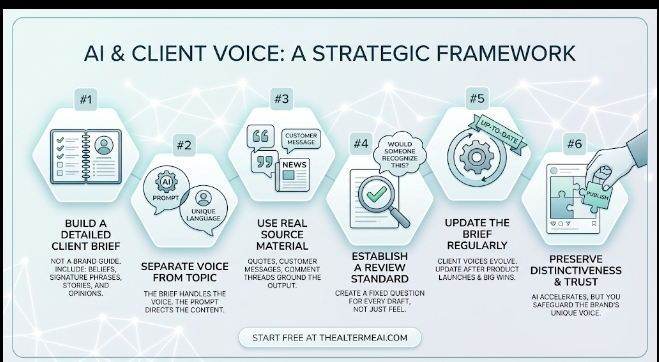
AI is not the problem. The way most social media managers deploy it is. Here is how to change that.
The Core Problem: AI Defaults to Average
When you open most AI tools and type a prompt, the model produces something that represents the statistical average of everything it has been trained on. For your topic. In your approximate tone. For an audience that vaguely matches yours.
That might work for one client in one niche on one good day. It does not scale across five clients in five different industries, each with a distinct voice. The average is the enemy of distinct. And distinct is exactly what clients are paying for.
Build a Separate Brief for Every Client
Before you generate a single post for a client, build their brief. Not a brand guide. A living document you actually reference.
The brief should hold their core beliefs about their industry. The language their customers use when they describe their problem. The opinions the client holds that most accounts in their space would not say. The things they would never post. Their signature phrases, their recurring themes, and the stories from their business that have resonated best with their audience.
This brief is the difference between AI that sounds like your client and AI that sounds like everyone else. It is also what protects you when a client asks how you maintain consistency at volume. Show them the brief. It is proof of a process.
Separate the Voice from the Topic
A common mistake is feeding AI both the topic and the tone in the same prompt. Write a LinkedIn post about our new feature launch in an enthusiastic, conversational tone. What comes back is the AI's interpretation of "enthusiastic" and "conversational," which may have nothing to do with the client.
Split the work. Let the brief handle the voice. Let the prompt handle the topic. When the voice is already established in the input, the prompt just needs to direct the content. The tone takes care of itself.
Use Real Material, Not Just Direction
The highest quality AI output for any client comes when you give it real source material, not just instructions. A quote from the founder in a recent interview. A customer message that captures exactly the problem the product solves. A comment thread where the audience responded in a way that revealed what they actually care about.
This material does two things. It grounds the output in specificity that instructions alone cannot produce. And it ensures that the content reflects something that actually happened, which is always more compelling than something constructed.
Create a Review Standard, Not a Review Process
Most social media managers review AI output by feel. They read it, decide if it sounds right, adjust what seems off, and post. This works until it does not. One busy week, and the standard shifts went unnoticed.
A better approach is to ask a fixed question of every draft before it goes live: Would someone who knows this client well recognize this as theirs?
This question is more useful than any checklist because it focuses on the outcome rather than the mechanics. It also makes client feedback easier to interpret. When a client says, "This does not sound like us," the question helps you diagnose exactly where the output drifted.
Update the Brief When Things Change
Client voices evolve. New products get launched. Audiences shift. A new hire changes the company's public tone. The brief needs to reflect this, or the AI starts working from an outdated version of the client.
Build the habit of updating the brief after any significant client conversation. After a product announcement. After a piece of content outperforms expectations and reveals something new about what the audience responds to.
The managers who get the most out of AI over time are the ones who treat the brief as a living asset, not a one-off task completed during onboarding. The brief is the product. The AI is just what runs on it.
Start free at TheAlterMeAI.