How to Build a Personal Knowledge Vault for AI
June 27, 2026 · 4 min read
There is a moment most founders and creators hit somewhere around month three of using AI for content. The posts are clean. The captions land grammatically. Everything looks fine. But something feels off, and engagement tells the story before they can name it.
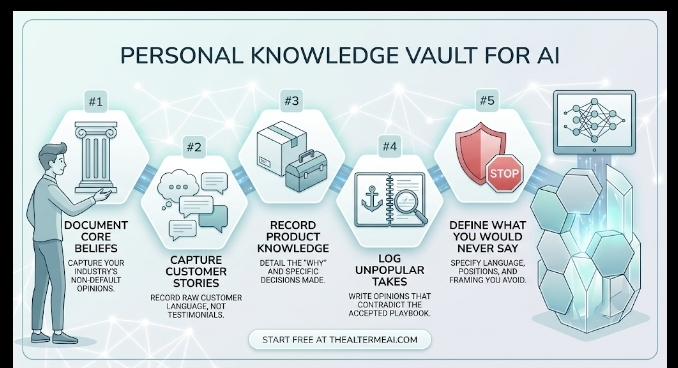
The AI is not broken. It is just empty. It knows how to write. It does not know them.
A personal knowledge vault fixes this. Not by making the AI smarter, but by giving it something real to work from. Here is how to build one that actually changes the output.
What a Knowledge Vault Actually Is
A knowledge vault is a structured repository of everything that makes your perspective your own. It is not a brand guidelines doc. It is not a style guide. It is the raw material of your thinking: your beliefs, your customer stories, your product knowledge, your angles, and the opinions you hold that most people in your space would not say out loud.
When an AI has access to this, it stops generating from the internet's general understanding of your topic and starts generating from yours. The output shifts from plausible to actually recognizable.
Step One: Document Your Core Beliefs
Start with three to five things you genuinely believe about your industry that are not the default opinion. Not controversy for its own sake. Just the things you would say in a room of peers that would make some people shift in their seats.
These beliefs are the backbone of your voice. They show up in how you frame problems, which stories you choose to tell, and what conclusions you draw. Feed them first. Everything else builds on them.
Step Two: Capture Your Customer Stories
The single most underused asset in most founders' content is the actual words their customers use. Not testimonials polished for a landing page. The raw version. The problem as the customer described it before your product existed. The moment they realized something had changed.
Write these down in your vault as close to the original language as possible. When AI draws on them, the specificity comes through. A post that references a real outcome from a real customer type reads entirely differently than one built on a hypothetical.
Step Three: Record Your Product Knowledge
Most AI tools know nothing about what you actually built, why you built it that way, or what makes it different from the alternative a potential customer is already using. Your vault should hold this.
Write down the problem your product solves in plain language. Write down the decision you made early on that surprised people. Write down what you would tell someone who is two steps away from buying but stuck on the wrong question. This becomes the raw material for posts, replies, and DM follow-ups that convert.
Step Four: Log Your Unpopular Takes
Every person who has spent real time in a field has at least a handful of opinions that contradict the accepted playbook. These are the highest-value entries in your vault because they are the hardest to replicate.
If you think a common practice in your space is overcomplicated, write it down. If you have a different read on a trend everyone else is celebrating, write it down. These takes are what make an account worth following. They cannot be borrowed from the internet because they are not available there.
Step Five: Define What You Would Never Say
A voice is defined as much by its edges as its center. Your vault should include the language, the positions, and the framing you would never use. Not as a policy document, but as a quick reference that keeps every output on the right side of your actual character.
This is especially useful when someone else is managing your accounts. It eliminates the drift that occurs when the person posting has to guess.
How to Use It
The vault is only valuable if it is active. Reference it before generating any post. Add to it after customer conversations, product updates, or any moment you say something in a meeting that gets a strong reaction.
Think of it as a briefing document you would hand a new team member on day one. Except it never gets outdated, because you keep updating it. And unlike a team member, the AI will use every line of it every time.
The accounts and businesses that win with AI are not using better prompts. They are using better input. The vault is the input.
Start free at TheAlterMeAI.